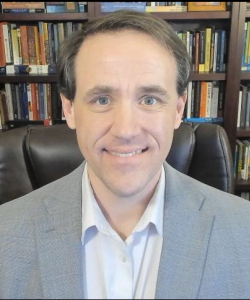
Kevin Vallier is a Professor of Philosophy at the University of Toledo, where he is Director of Research at the Institute of American Constitutional Thought and Leadership.
Vallier’s interests lie primarily in political philosophy, ethics, philosophy of religion, and philosophy, politics, and economics (PPE). He is the author of four monographs, five edited volumes, and over sixty peer-reviewed book chapters and journal articles. His books include Liberal Politics and Public Faith: Beyond Separation (Routledge 2014), Must Politics Be War? Restoring Our Trust in the Open Society (Oxford UP 2019), and Trust in a Polarized Age (Oxford UP 2020). His newest book is All the Kingdoms of the World: On Radical Religious Alternatives to Liberalism (Oxford UP 2023). His next book will assess the prospects for liberty, virtue, and order in the era of agentic capitalism. For more information, see kevinvallier.com or follow him @kvallier on Twitter.
I am a Professor of Philosophy at the University of Toledo, where I serve as Director of Research at the Institute of American Constitutional Thought and Leadership. I am, first and foremost, a political philosopher, but I am drawn to questions at the intersection of political philosophy and other fields, especially political economy and political theology. I currently have three research projects.
My work in political economy concerns the nature of social trust (trust in strangers and society broadly). I am interested in particular in how societies develop social trust. At some point, human beings learned to trust strangers with their lives, and I want to know how that happened. Together with Cristina Bicchieri, we are laying the theoretical foundation for a trust learning theory where social norms serve as proxies for trust. My work on social trust builds on Bicchieri’s work on social norms, a theory I advanced in my books Must Politics Be War? And Trust in a Polarized Age.
In political philosophy, I have written chiefly on the liberal tradition, particularly the public reason tradition, but as of late, I engage conservative thinkers. My next book explores the coherence of fusionist (limited government) conservatism. Fusionism seems to have died in the face of right-wing populism, and many say that’s because the doctrine was always incoherent. I don’t think that’s true.
In political theology, I have a number of projects. My last book engaged the political theological doctrine known as Catholic integralism, the most intellectually serious of the political doctrines found on the New Right. In All the Kingdoms of the World: On Radical Religious Alternatives to Liberalism, I developed a systematic critique of integralism that can be expanded to other forms of religious anti-liberalism. My next project in political theology will engage how Christian theology, especially in the Orthodox tradition, can resolve a tension in the history of Western political thought between the natural law and social contract traditions. A reconciliation of these traditions on Christian grounds would lay the foundation for a civilizational ethos for a new polycentric Christendom that can carry Christian civilization into the age of intelligence.